Waterfall Methodology vs Agile: The Ultimate Guide to Choosing the Right Project Management Approach
Choosing between waterfall methodology and agile can make or break your project's success. This comprehensive guide reveals exactly when to use each approach, complete with real-world examples and a proven decision framework.
Waterfall Methodology vs Agile: The Ultimate Guide to Choosing the Right Project Management Approach
In the boardroom of a major construction company, project managers huddle around architectural blueprints, meticulously planning each phase of a skyscraper's construction. Meanwhile, across town, a software development team gathers for their daily standup, ready to adapt their product based on yesterday's user feedback. These two scenarios perfectly illustrate one of the most fundamental decisions facing project managers today: choosing between waterfall methodology and agile approaches.
The stakes couldn't be higher. Research shows that organizations using the wrong project management methodology are 50% more likely to experience project failure, cost overruns, and missed deadlines. Yet despite decades of debate, there's no one-size-fits-all answer. The key lies in understanding when each methodology shines and having the framework to make the right choice for your specific situation.
This comprehensive guide will walk you through everything you need to know about waterfall and agile methodologies, providing you with the insights and tools necessary to make informed decisions that drive project success.
Understanding the Waterfall Methodology: A Sequential Approach to Project Success
Picture a waterfall cascading down a mountainside – water flows in one direction, from top to bottom, never returning upward. This natural phenomenon perfectly captures the essence of the waterfall methodology, a sequential project approach that has guided countless successful projects since the 1950s.
The waterfall methodology is a linear project management methodology where each phase must be completed before the next one begins. Unlike iterative approaches, waterfall follows a structured, step-by-step progression that prioritizes thorough planning, comprehensive documentation, and predictable outcomes.
The Historical Foundation
The waterfall methodology didn't emerge from the tech world – it has its roots in manufacturing and construction industries where sequential processes were essential for success. Dr. Winston Royce first formalized this approach in 1970, drawing inspiration from assembly lines and architectural projects where changing direction mid-stream would be costly or impossible.
Manufacturing companies like Ford had already proven that sequential processes could deliver consistent, high-quality results. Construction projects demonstrated that some activities simply couldn't begin until others were complete – you can't install plumbing before pouring the foundation.
The Five Core Phases
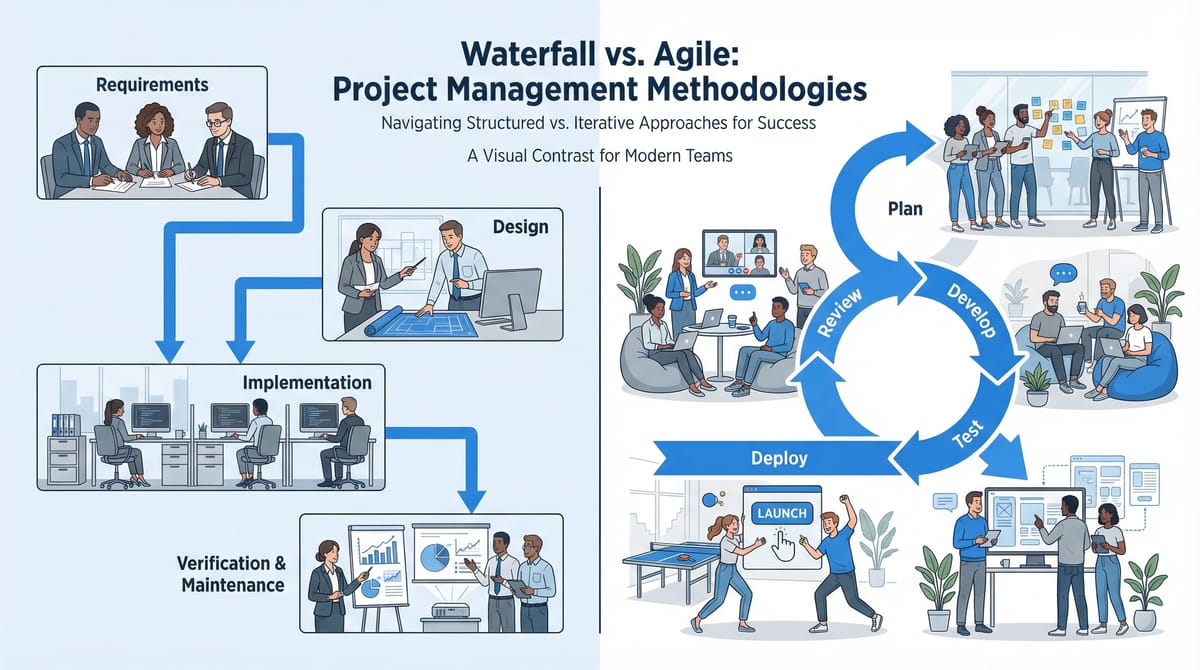
The waterfall methodology operates through five distinct phases, each with specific deliverables and approval gates:
Requirements Phase: Teams gather and document all project requirements, creating detailed specifications that serve as the project's foundation. Stakeholders define what success looks like, establishing clear boundaries and expectations.
Design Phase: Based on approved requirements, teams create detailed system architecture, user interface mockups, and technical specifications. This phase transforms requirements into actionable blueprints.
Implementation Phase: Development teams build the solution according to design specifications. This is typically the longest phase, where the actual product takes shape.
Testing Phase: Quality assurance teams verify that the solution meets all requirements and functions as designed. Any defects are identified and resolved before deployment.
Deployment Phase: The completed solution is rolled out to end users, accompanied by training, documentation, and ongoing support plans.
Documentation and Approval Gates
One of waterfall methodology's defining characteristics is its documentation-heavy nature. Each phase produces comprehensive documentation that serves multiple purposes: communication tools, approval mechanisms, and historical records for future projects.
Formal approval gates ensure stakeholders review and sign off on deliverables before teams proceed. These checkpoints prevent scope creep and maintain project alignment, though they can also slow down progress when changes are needed.
Predictability as a Strength
The waterfall methodology's greatest strength lies in its predictability and control. Project managers can create detailed timelines, accurate budgets, and clear milestone schedules. Stakeholders know exactly what to expect and when to expect it.
This predictability makes waterfall methodology particularly valuable for projects with fixed budgets, strict deadlines, or regulatory requirements. When you need to guarantee specific outcomes within defined constraints, waterfall's structured approach provides the control necessary for success.
Agile Project Management: Embracing Flexibility and Iterative Development
In stark contrast to waterfall's linear progression, agile methodology resembles a jazz ensemble – structured yet improvisational, disciplined yet flexible, always ready to adapt to the moment's needs while maintaining harmony toward a common goal.
Agile methodology represents an iterative project management approach that prioritizes flexibility, collaboration, and rapid response to change. Rather than following a predetermined path, agile teams work in short cycles, continuously gathering feedback and adjusting their approach based on what they learn.
The Agile Manifesto Foundation
The Agile Manifesto, created in 2001 by seventeen software developers, established four core values that continue to guide agile implementations:
- Individuals and interactions over processes and tools
- Working software over comprehensive documentation
- Customer collaboration over contract negotiation
- Responding to change over following a plan
These values don't dismiss the importance of processes, documentation, contracts, or plans – they simply prioritize human elements and adaptability when conflicts arise.
Popular Agile Frameworks
Several frameworks have emerged to implement agile principles effectively:
Scrum organizes work into fixed-length sprints (typically 2-4 weeks), with defined roles (Product Owner, Scrum Master, Development Team) and ceremonies (sprint planning, daily standups, reviews, retrospectives). Scrum provides structure while maintaining agile flexibility.
Kanban visualizes workflow through boards showing work in different stages (To Do, In Progress, Done). Teams pull work based on capacity rather than committing to fixed sprint goals, allowing for continuous flow and real-time prioritization.
Lean focuses on eliminating waste and maximizing value delivery. Originally from manufacturing, Lean principles help agile teams streamline processes and focus on activities that directly benefit customers.
Customer Collaboration and Change Response
Agile methodology thrives on continuous customer collaboration. Rather than gathering requirements once at the beginning, agile teams regularly engage stakeholders to validate assumptions, gather feedback, and adjust priorities.
This approach transforms change from a project risk into a competitive advantage. When market conditions shift or new opportunities emerge, agile teams can pivot quickly rather than being locked into outdated plans.
Key Agile Concepts
Sprints are time-boxed iterations where teams focus on delivering working software. Each sprint includes planning, development, testing, and review activities, creating mini-projects within the larger effort.
User stories replace traditional requirements documents with simple, user-focused descriptions of desired functionality. Stories typically follow the format: "As a [user type], I want [functionality] so that [benefit]."
Continuous delivery ensures that software is always in a deployable state. Rather than waiting months for a major release, teams can ship improvements frequently, gathering real-world feedback and delivering value continuously.
Waterfall vs Agile: Head-to-Head Project Methodology Comparison
To truly understand when to choose waterfall methodology versus agile, we need to examine how these approaches differ across critical project dimensions. This project methodology comparison reveals distinct strengths and trade-offs that influence methodology selection.
Comprehensive Comparison Framework
| Aspect | Waterfall Methodology | Agile Methodology |
|---|---|---|
| Project Timeline | Linear, sequential phases with fixed milestones | Iterative cycles with flexible, evolving timelines |
| Requirements | Comprehensive upfront documentation | Evolving user stories and acceptance criteria |
| Testing | Dedicated phase after development completion | Continuous testing throughout development |
| Customer Involvement | Limited to requirements and final delivery | Continuous collaboration and feedback |
| Change Management | Formal change control processes | Welcome change as competitive advantage |
| Documentation | Extensive, formal documentation required | Working software prioritized over documentation |
| Risk Management | Identified and mitigated in planning phase | Addressed through short iterations and frequent delivery |
| Team Structure | Specialized roles with handoffs between phases | Cross-functional, self-organizing teams |
Timeline and Milestone Approaches
Waterfall methodology creates predictable timelines with clearly defined milestones. Project managers can confidently communicate delivery dates and budget requirements months or even years in advance. This predictability enables better resource planning and stakeholder coordination.
Agile vs waterfall timeline management differs significantly. Agile projects focus on delivering value incrementally rather than hitting predetermined milestones. While this creates uncertainty about final delivery dates, it ensures continuous value delivery and reduces the risk of complete project failure.
Team Structure and Communication
Traditional waterfall projects organize teams around specialized functions. Business analysts gather requirements, architects create designs, developers write code, and testers verify quality. Each group completes their work before passing deliverables to the next phase.
Agile methodology promotes cross-functional teams where members collaborate continuously rather than working in isolation. Daily standups, sprint reviews, and retrospectives create regular communication cadences that keep everyone aligned and informed.
Risk Management Strategies
Waterfall methodology addresses risk through comprehensive upfront planning. Teams identify potential issues early and create mitigation strategies before development begins. This approach works well when risks are predictable and can be planned for in advance.
Agile methodology manages risk through rapid iteration and frequent delivery. Rather than trying to predict all risks upfront, agile teams discover and address issues quickly through short feedback cycles. This approach is particularly effective when dealing with uncertain or evolving requirements.
Cost Predictability and Budget Control
Budget predictability represents one of waterfall methodology's strongest advantages. Detailed upfront planning enables accurate cost estimation and budget control throughout the project lifecycle. Finance teams can plan expenditures and measure progress against predetermined budgets.
Agile projects often require more flexible budget approaches. While individual sprint costs can be predicted accurately, total project costs depend on how requirements evolve and how much value teams deliver. This uncertainty challenges traditional budget management but enables better return on investment optimization.
The Pros and Cons: When Waterfall Methodology Shines (and When It Doesn't)
Every project management methodology comes with inherent strengths and limitations. Understanding when waterfall methodology excels – and when it struggles – is crucial for making informed methodology decisions that drive project success.
Waterfall Methodology Advantages
Clear Milestones and Predictable Timelines represent waterfall's most significant strengths. Stakeholders know exactly what deliverables to expect and when they'll be completed. This predictability enables better resource planning, budget management, and stakeholder communication.
Project managers can create detailed Gantt charts showing dependencies, critical paths, and resource allocation throughout the entire project lifecycle. This visibility helps organizations coordinate multiple projects and manage competing priorities effectively.
Comprehensive Documentation ensures knowledge preservation and regulatory compliance. Every requirement, design decision, and change is documented, creating valuable organizational assets that survive team changes and support future maintenance efforts.
Industries with strict regulatory requirements benefit enormously from waterfall's documentation approach. FDA-regulated medical device projects, government contracts, and financial services applications often require extensive documentation for compliance and audit purposes.
Ideal Scenarios for Waterfall Success
Waterfall methodology excels in several specific contexts:
Fixed-Scope Projects with well-understood requirements benefit from waterfall's structured approach. When stakeholders know exactly what they want and requirements are unlikely to change, waterfall's linear progression eliminates uncertainty and reduces costs.
Regulatory Compliance Projects requiring extensive documentation and approval processes align naturally with waterfall's phase-gate structure. Each approval checkpoint ensures compliance requirements are met before proceeding.
Large-Scale Infrastructure Projects where sequential dependencies exist naturally – you can't test software before it's built, or train users before the system exists – benefit from waterfall's logical progression.
Waterfall Methodology Disadvantages
Limited Flexibility represents waterfall's greatest weakness in today's dynamic business environment. Once requirements are approved and development begins, making changes becomes expensive and disruptive to project timelines.
Organizations using waterfall methodology often discover that their original requirements assumptions were incorrect, but changing course requires formal change control processes that add time and cost to projects.
Late Testing Phase delays problem discovery until significant investment has already been made. If fundamental design issues emerge during testing, fixing them may require revisiting earlier phases, causing substantial delays and cost overruns.
Customer Feedback Gaps mean stakeholders don't see working solutions until projects are nearly complete. This delay increases the risk of delivering solutions that don't meet actual user needs or market conditions.
Challenging Scenarios for Waterfall
Waterfall methodology struggles when:
Requirements are uncertain or evolving – lengthy upfront planning becomes counterproductive when needs change frequently.
Innovation is required – breakthrough solutions often emerge through experimentation rather than detailed planning.
Time-to-market is critical – waiting for complete solutions before delivery can mean missing market opportunities.
User feedback is essential – understanding user needs requires interaction with working software rather than specifications.
Agile Advantages and Limitations: Understanding the Trade-offs
While agile methodology has gained significant popularity across industries, it's not a universal solution. Understanding agile's benefits and limitations helps organizations make informed decisions about when agile approaches deliver maximum value.
Agile Methodology Benefits
Faster Value Delivery stands out as agile's primary advantage. Rather than waiting months or years for complete solutions, stakeholders receive working software every few weeks. This rapid delivery enables earlier return on investment and faster market feedback.
Teams using agile methodology can respond to market opportunities within weeks rather than months. When competitors launch new features or customer needs shift, agile teams adapt quickly rather than being locked into outdated plans.
Enhanced Customer Satisfaction emerges from continuous collaboration and feedback incorporation. Customers influence solution development throughout the process rather than hoping final deliverables meet their evolving needs.
Regular demonstrations and feedback sessions ensure solutions align with actual user requirements. This ongoing validation reduces the risk of building features users don't need or want.
Superior Adaptability to Change transforms uncertainty from a project risk into a competitive advantage. Agile teams expect change and have processes designed to incorporate new information quickly and efficiently.
Continuous Improvement Culture
Agile methodology promotes organizational learning through regular retrospectives and process refinement. Teams continuously evaluate what's working well and what needs improvement, creating a culture of ongoing optimization.
Early Problem Detection through short iterations and frequent testing prevents small issues from becoming major problems. Teams discover integration challenges, performance bottlenecks, and user experience issues while they're still manageable.
Enhanced Team Collaboration breaks down silos between different functions. Developers, testers, designers, and business stakeholders work together continuously rather than in isolation.
Agile Methodology Limitations
Scope Creep Potential represents one of agile's most significant challenges. The flexibility that makes agile powerful can also lead to continuously expanding project scope without corresponding timeline or budget adjustments.
Without proper discipline and stakeholder management, agile projects can continue indefinitely as new features and improvements are constantly identified and prioritized.
Less Predictable Timelines challenge organizations accustomed to fixed delivery commitments. While agile teams can estimate when specific features will be complete, predicting total project duration becomes more difficult.
Documentation Gaps can create maintenance challenges and knowledge transfer issues. While agile prioritizes working software over comprehensive documentation, some documentation is still necessary for long-term success.
Challenging Contexts for Agile
Agile methodology faces difficulties when:
Inexperienced Teams lack the self-organization skills and technical expertise required for effective agile implementation. Agile's success depends heavily on team capability and experience.
Limited Stakeholder Commitment prevents the continuous collaboration agile requires. If stakeholders can't participate regularly in reviews and feedback sessions, agile's benefits diminish significantly.
Strict Regulatory Requirements demand extensive documentation and formal approval processes that conflict with agile's lightweight approach.
Fixed-Budget Constraints make it difficult to accommodate the iterative discovery and scope evolution that characterize successful agile projects.
Industry Use Cases: Real-World Applications of Each Methodology
Understanding how different industries apply waterfall methodology and agile approaches provides valuable insights for methodology selection. Real-world applications demonstrate that success often depends on matching methodology characteristics with industry requirements and project contexts.
Waterfall Methodology Success Stories
Construction and Infrastructure Projects represent waterfall methodology's natural habitat. Building a bridge requires completing foundation work before installing superstructure components. Electrical systems can't be installed before structural framing is complete.
The Panama Canal expansion project exemplifies waterfall success at massive scale. Engineers created detailed plans spanning multiple years, with each construction phase building on previous work. Change management processes ensured modifications were carefully evaluated for their impact on subsequent phases.
Manufacturing and Product Development in regulated industries relies heavily on waterfall approaches. Automotive manufacturers use waterfall methodology for new vehicle development, where safety testing requirements and manufacturing tooling investments make iterative approaches impractical.
Boeing's aircraft development process demonstrates waterfall methodology's value for complex, regulated products. Every component must be thoroughly designed, tested, and certified before integration, making sequential phases essential for success.
Government and Public Sector Projects often mandate waterfall methodology through procurement requirements and oversight processes. Large-scale IT implementations for agencies like the Department of Defense require extensive documentation, formal approval processes, and predictable milestone achievement.
The U.S. Census Bureau's decennial planning process uses waterfall methodology to coordinate massive logistical operations spanning multiple years. Sequential planning phases ensure all components are ready for the critical data collection period.
Agile Implementation Success Stories
Software Development and Technology industries pioneered agile methodology adoption with remarkable results. Netflix's transition from DVD-by-mail to streaming required continuous adaptation as market conditions and user preferences evolved rapidly.
Spotify's agile implementation enables rapid feature deployment and experimentation. Their "squad" model demonstrates how agile principles scale across large technology organizations while maintaining startup-like agility.
Marketing and Campaign Development benefits enormously from agile approaches. Digital marketing campaigns require constant optimization based on performance data, user engagement metrics, and competitive responses.
HubSpot uses agile methodology for content marketing, allowing teams to adjust messaging, targeting, and channel strategies based on real-time performance data rather than sticking to predetermined annual plans.
Product Design and User Experience projects thrive under agile methodology. Understanding user needs requires iterative testing, feedback incorporation, and design refinement that waterfall's linear approach cannot accommodate effectively.
Hybrid Approaches: The Best of Both Worlds
Many organizations discover that pure waterfall methodology or agile approaches don't perfectly match their needs. Hybrid methodologies combine elements from both approaches to address specific organizational requirements and constraints.
Water-Scrum-Fall uses waterfall methodology for high-level planning and requirements definition, agile approaches for development and testing, then returns to waterfall for deployment and maintenance. This combination provides upfront predictability while enabling development flexibility.
Large financial institutions often adopt hybrid approaches for regulatory compliance reasons. Requirements gathering and architecture design follow waterfall processes to ensure compliance documentation, while development teams use agile methods for implementation speed and flexibility.
Industry-Specific Considerations
Pharmaceutical Research requires hybrid approaches that combine waterfall methodology's documentation requirements with agile's adaptive capabilities. Clinical trials follow regulated waterfall processes, while data analysis and research planning benefit from agile flexibility.
Educational Technology projects often use agile methodology during development phases but switch to waterfall approaches for curriculum integration and teacher training rollouts that require predictable timelines.
Healthcare Systems Implementation must balance agile's user feedback benefits with waterfall's regulatory compliance strengths. Patient safety requirements often mandate waterfall documentation while user experience optimization benefits from agile iteration.
The Decision Framework: How to Choose Between Waterfall and Agile
Choosing the right project methodology requires systematic evaluation of multiple factors that influence project success. This decision framework provides structured criteria for making informed waterfall vs agile choices that align with your specific project context and organizational capabilities.
Project Characteristics Assessment
Start by evaluating your project's fundamental characteristics:
Requirements Clarity serves as a primary decision factor. Projects with well-defined, stable requirements favor waterfall methodology, while projects with uncertain or evolving requirements benefit from agile approaches.
Ask yourself: Can we define 80% of project requirements upfront with confidence? Are these requirements likely to remain stable throughout the project? If yes, waterfall methodology provides structure and predictability. If no, agile methodology offers the flexibility needed to adapt as understanding evolves.
Project Complexity and Innovation Level influence methodology effectiveness. Routine projects with established solutions work well with waterfall methodology, while innovative projects requiring experimentation and discovery benefit from agile approaches.
Timeline and Deadline Flexibility determines how methodology choice affects project success. Fixed deadlines with inflexible scope requirements often favor waterfall methodology's predictable progression. Flexible timelines with value-driven priorities align better with agile methodology.
Team Readiness Evaluation
Your team's capabilities and experience significantly impact methodology success:
Technical Expertise and Experience levels determine implementation feasibility. Agile methodology requires self-organizing teams with strong technical skills and experience making autonomous decisions. Less experienced teams often benefit from waterfall methodology's structured guidance and clear role definitions.
Stakeholder Availability and Commitment affects methodology viability. Agile methodology requires continuous stakeholder engagement for feedback and priority decisions. Limited stakeholder availability makes waterfall methodology's upfront planning and minimal ongoing involvement more practical.
Organizational Culture and Change Readiness influences adoption success. Organizations comfortable with uncertainty and rapid change adapt well to agile methodology. Companies preferring predictability and formal processes often find waterfall methodology more culturally compatible.
Constraint Analysis
Evaluate project constraints that limit methodology options:
Budget Predictability Requirements vary significantly between methodologies. Projects requiring fixed-price contracts and predictable budget consumption favor waterfall methodology. Organizations comfortable with value-based budgeting and iterative investment can leverage agile methodology's adaptive benefits.
Regulatory and Compliance Needs often mandate specific methodology elements. Industries requiring extensive documentation, formal approval processes, and audit trails may find waterfall methodology more suitable for compliance requirements.
Risk Tolerance and Mitigation Strategies align differently with each methodology. Risk-averse organizations often prefer waterfall methodology's upfront planning and predictable outcomes. Organizations comfortable with managed risk-taking can leverage agile methodology's rapid learning and adaptation capabilities.
Decision Matrix Application
Create a weighted decision matrix evaluating your project against these criteria:
- Requirements stability (25% weight)
- Team experience and capability (20% weight)
- Timeline flexibility (15% weight)
- Budget predictability needs (15% weight)
- Stakeholder availability (15% weight)
- Regulatory requirements (10% weight)
Score each methodology (1-5 scale) against your project's specific context. Multiply scores by weights to calculate total methodology fit scores.
This quantitative approach provides objective methodology comparison while acknowledging that some projects may benefit from hybrid approaches combining elements from both methodologies.
Implementation Best Practices for Both Methodologies
Successful methodology implementation requires more than just choosing waterfall methodology or agile approaches – it demands careful attention to best practices, tool selection, and organizational change management that support long-term project success.
Waterfall Methodology Implementation Excellence
Phase Gate Reviews and Quality Checkpoints form the foundation of effective waterfall implementation. Establish clear criteria for phase completion, including deliverable quality standards, stakeholder approval requirements, and readiness assessments for subsequent phases.
Create standardized review templates that ensure consistent evaluation across different projects and teams. Include technical quality criteria, business requirement satisfaction, and risk assessment components in every phase gate review.
Documentation Standards and Knowledge Management systems preserve project knowledge and enable future maintenance efforts. Develop templates for requirements specifications, design documents, test plans, and user manuals that ensure consistency and completeness.
Implement version control systems for all project documentation, enabling teams to track changes, understand decision rationale, and maintain historical records for future reference and compliance requirements.
Risk Mitigation and Contingency Planning strategies address potential issues before they impact project timelines or budgets. Create risk registers during planning phases, identifying potential problems, probability assessments, impact analysis, and specific mitigation strategies.
Regular risk review meetings throughout project execution ensure emerging issues are identified and addressed promptly. Establish escalation procedures for risks that exceed predetermined thresholds or require additional resources to resolve.
Agile Implementation Best Practices
Sprint Planning and Backlog Management processes ensure teams focus on highest-value activities while maintaining sustainable development pace. Establish clear definition of ready criteria for user stories entering sprints and definition of done standards for completed work.
Implement effective backlog grooming sessions where product owners, developers, and stakeholders collaborate to refine requirements, estimate effort, and prioritize features based on business value and technical dependencies.
Daily Standups and Communication Rhythms maintain team alignment and identify impediments quickly. Structure daily meetings around three key questions: What did I accomplish yesterday? What will I work on today? What obstacles are blocking my progress?
Keep standup meetings focused and time-boxed (15 minutes maximum) while ensuring all team members understand project status and can offer assistance when colleagues face challenges.
Retrospectives and Continuous Improvement culture enables teams to optimize processes and address systemic issues. Conduct retrospectives at the end of each sprint, focusing on what worked well, what needs improvement, and specific actions the team will take in the next iteration.
Track improvement actions and measure their impact on team velocity, quality metrics, and stakeholder satisfaction to ensure continuous improvement efforts deliver measurable benefits.
Tool Selection and Technology Support
Project Management Software selection should align with methodology requirements and team workflows. Waterfall projects benefit from tools like Microsoft Project or Smartsheet that excel at Gantt chart creation, resource planning, and milestone tracking.
Agile teams often prefer tools like Jira, Azure DevOps, or Trello that support user story management, sprint planning, and kanban board visualization while integrating with development and testing tools.
Collaboration and Communication Platforms become critical for distributed teams and stakeholder engagement. Implement tools that support real-time communication, document sharing, and video conferencing while maintaining security and compliance requirements.
Change Management and Training Strategies
Organizational Change Management helps teams transition from existing processes to new methodology approaches. Develop communication plans that explain methodology benefits, address concerns, and provide clear timelines for implementation rollout.
Identify change champions within each team who can provide peer support, answer questions, and reinforce new processes during the transition period. These champions often become methodology experts who support future project implementations.
Training and Skill Development programs ensure teams have necessary capabilities for methodology success. Provide role-specific training that addresses project managers, team members, and stakeholders' different needs and responsibilities.
Create ongoing learning opportunities through lunch-and-learn sessions, internal communities of practice, and external conference attendance that keep teams current with methodology evolution and industry best practices.
Success Measurement and KPIs
Waterfall Success Metrics focus on schedule adherence, budget compliance, and scope completion. Track milestone achievement rates, cost variance from planned budgets, and defect rates discovered during testing phases.
Monitor stakeholder satisfaction with deliverable quality and project communication effectiveness throughout the project lifecycle, not just at completion.
Agile Success Indicators emphasize value delivery, customer satisfaction, and team productivity. Measure sprint completion rates, velocity trends, and customer feedback scores from regular demonstrations and releases.
Track team health indicators like retrospective action completion, team member satisfaction surveys, and knowledge sharing activities that support long-term project success and organizational learning.
FAQ Section
Q: What is the main difference between waterfall methodology and agile?
A: The main difference lies in their approach to project execution. Waterfall methodology follows a linear, sequential process where each phase must be completed before moving to the next, while agile uses iterative cycles that allow for continuous feedback and adaptation throughout the project lifecycle.
Q: When should you use waterfall methodology instead of agile?
A: Use waterfall methodology when you have well-defined requirements, fixed scope, regulatory compliance needs, or when working with inexperienced teams. It's ideal for projects in construction, manufacturing, or government sectors where predictability and documentation are crucial.
Q: Is waterfall methodology outdated compared to agile?
A: No, waterfall methodology is not outdated. While agile has gained popularity in software development, waterfall remains highly effective for projects with stable requirements, clear timelines, and industries requiring extensive documentation and regulatory compliance.
Q: Can you combine waterfall and agile methodologies?
A: Yes, hybrid approaches combining waterfall and agile elements can be effective. For example, using waterfall for high-level planning and requirements gathering, then switching to agile for development and testing phases. This approach is often called 'Water-Scrum-Fall.'
Q: Which methodology is better for software development projects?
A: Agile is generally better for software development because it accommodates changing requirements, enables faster feedback loops, and allows for iterative improvements. However, waterfall can work for software projects with very stable requirements and strict regulatory compliance needs.
Q: How do you measure success in waterfall vs agile projects?
A: Waterfall projects typically measure success through milestone completion, budget adherence, and deliverable quality against initial specifications. Agile projects focus on customer satisfaction, working software delivery frequency, team velocity, and adaptability to changing requirements.
Ready to implement the right project management methodology for your team? Download our free Project Methodology Selection Toolkit, complete with assessment templates, implementation checklists, and decision frameworks to ensure your next project succeeds from day one.